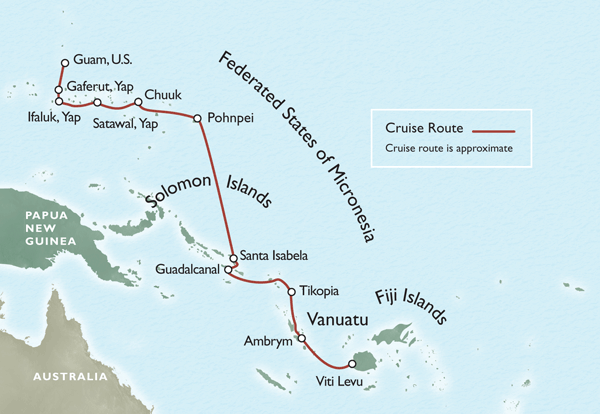
NORTHBOUND ITINERARY / SOUTHBOUND ITINERARY
Day 1 - DEPART FOR FIJI
Day 2 - ARRIVE INTO FIJI
Day 3 - NADI/LAUTOKA, FIJI Enjoy a sightseeing tour of Nadi and the surrounding area before checking into individual day rooms at the Westin Resort Denarau.
D Day 4 - AT SEA
BLD Day 5 - AMBRYM ISLAND, VANUATU Visit the local village, where you'll meet with the villagers, and have the opportunity to purchase handicrafts. Ambrym is the home of Mt. Marum and Mt. Benbow volcanoes and holds the greatest reputation for sorcery in Vanuatu. The island is also known for traditional crafts such as tam-tams (vertical, slit drums) and tree fern sculptures.
BLD Day 6 - TIKOPIA, SOLOMON ISLANDS The Solomon Islands have long been known for their fierce headhunting tribes, which has led to the islands' isolation until only recently. Tikopia, in particular, is home to a remote society that has changed little over the years. It is still ruled by four clans, each with a chief who may only be approached by crawling.
BLD Day 7 - AT SEA
BLD Day 8 - GUADALCANAL, SOLOMON ISLANDS Guadalcanal was the focus of a six-month battle that was a turning point in the Pacific War. The fierce fighting that took place here littered the area with relics, both on land and sea.
BLD Day 9 - SANTA ISABELA ISLAND, SOLOMON ISLANDS Anchor off Kia village, once home to headhunters. Other enduring traditions here include making tapa cloth from the bark of the paper-mulberry tree and tinting it a pale blue using a dye made of crushed orchid leaves.
BLD Day 10 - AT SEA
BLD Day 11 - AT SEA BLD
Day 12 - POHNPEI, ISLAND FSM The snorkeling is magnificent here, and birdwatchers will want to keep their eyes peeled for the endemic Pohnpei fantail and Pohnpei flycatcher. But the highlight of the island is the ruins of Nan Madol, said to be over 700 years old.
BLD Day 13 - AT SEA BLD
Day 14 - TONOAS, CHUUK Appreciate the World War II history of this mangrove-fringed island in a beautiful lagoon. Have time for snorkeling or swimming.
BLD Day 15 - SATAWAL ISLAND, YAP Some of the best traditional navigators in the Pacific live here, still navigating by the stars and ocean swells. Visit their village and go snorkeling on the reef.
BLD Day 16 - IFALUK, YAP The inhabitants of Ifaluk are the most traditional of all the Eastern Caroline Islands, and the inner lagoon is shallow and breathtakingly beautiful. Visit with villagers, and see them perform dances. The reefs here are alive with colorful fish and deep-sea fans that will delight snorkelers.
BLD Day 17 - GAFARUT ATOLL, YAP Birds and turtles have discovered Gaferut's charms, but few others visit this migratory resting place. Birdwatchers keep a lookout for noddies, terns, and boobies. Just a few steps offshore great snorkeling awaits.
BLD Day 18 - GUAM, U.S. This morning you'll enjoy a tour of Guam including Plaza de Espana and Isla Center for the Arts.
B Day 19 - GUAM/HOME CITIES Transfer to the airport for your flight home.
Day 1 - DEPART FOR GUAM, U.S. Lose a day en route.
Day 2 - ARRIVE INTO GUAM, U.S. Upon arrival, transfer to the Guam Hyatt Regency where you'll stay overnight.
Day 3 - GUAM This morning you'll enjoy a tour of Guam including Plaza de Espana and Isla Center for the Arts. Board theSpirit of Oceanus.
B Day 4 - GAFERUT ATOLL, YAP Birds and turtles have discovered Gaferut's charms, but few others visit this migratory resting place. Birdwatchers keep a lookout for noddies, terns, and boobies. Just a few steps offshore great snorkeling awaits.
BLD Day 5 - IFALUK, YAP The inhabitants of Ifaluk are the most traditional of all the Eastern Caroline Islands, and the inner lagoon is shallow and breathtakingly beautiful. Visit with villagers, and see them perform dances. The reefs here are alive with colorful fish and deep-sea fans that will delight snorkelers.
BLD Day 6 - SATAWAL ISLAND, YAP Some of the best traditional navigators in the Pacific live here, still navigating by the stars and ocean swells. Visit their village and go snorkeling on the reef.
BLD Day 7 - TONOAS ISLAND, CHUUK Appreciate the World War II history of this mangrove-fringed island in a beautiful lagoon. Have time for snorkeling or swimming.
BLD Day 8 - CHRISTMAS CELEBRATION AT SEA
BLD Day 9 - POHNPEI ISLAND, FSM The snorkeling is magnificent here, and birdwatchers will want to keep their eyes peeled for the endemic Pohnpei fantail and Pohnpei flycatcher. But the highlight of the island is the ruins of Nan Madol, said to be over 700 years old.
BLD Day 10 - AT SEA Cross the Equator en route. As we cruise between islands, our Exploration Leader and other experts will brief us on the natural history and cultures we are about to visit.
BLD Day 11 - AT SEA, CONTINUED.
BLD Day 12 - SANTA ISABELA ISLAND, SOLOMON ISLANDS Anchor off Kia village, once home to headhunters. Other enduring traditions here include making tapa cloth from the bark of the paper-mulberry tree and tinting it a pale blue using a dye made of crushed orchid leaves.
BLD Day 13 - GUADALCANAL, SOLOMON ISLANDS Guadalcanal was the focus of a six-month battle that was a turning point in the Pacific War. The fierce fighting that took place here littered the area with relics, both on land and sea.
BLD Day 14 - RING IN THE NEW YEAR AT SEA BLD
Day 15 - TIKOPIA, SOLOMON ISLANDS The Solomon Islands have long been known for their fierce headhunting tribes, which has led to the islands' isolation until only recently. Tikopia, in particular, is home to a remote society that has changed little over the years. It is still ruled by four clans, each with a chief who may only be approached by crawling.
BLD Day 16 - AMBRYM, VANUATU Visit the local village, where you'll meet with the villagers, and have the opportunity to purchase handicrafts. Ambrym is the home of Mt. Marum and Mt. Benbow volcanoes and holds the greatest reputation for sorcery in Vanuatu. The island is also known for traditional crafts such as tam-tams (vertical, slit drums) and tree fern sculptures.
BLD Day 17 - AT SEA BLD
Day 18 - NADI/LAUTOKA, FIJI Disembark and enjoy a sightseeing tour of Nadi and the surrounding area before checking into individual day rooms at the Westin Resort Denarau. Transfer to the airport for your overnight flight home. B
The Solomons remained relatively unexplored except during World War II when all sides valued their strategic position. Guadalcanal was, of course, the setting for one of the most fiercely fought battles of WW2. The Guadalcanal Campaign of 1942-3 is regarded as one of the most crucial Allied victories, if not the actual turning point of the war in the Pacific. The evidence of this campaign can be seen in many sights on and around Guadalcanal, including Bloody Ridge, Henderson Field (now the Solomon's international airport), Mataniko River, Red Beach, Western and Eastern Battlefields, and the huge number of divable shipwrecks and aircraft. In addition to being the subject of numerous books, the battle featured in the recent film "The Thin Red Line", which was shot partly on Guadalcanal. Guadalcanal is the largest island in the Solomon Islands. It hosts the nation's largest city and Capitol of the Solomon Islands, Honiara. Honiara city is a port and commercial centre on the northern coast of Guadalcanal Island, which sprang up during World War II. The port primarily trades in coconuts, palm products, and timber both locally and internationally.
Santa Isabela Island, Solomon Islands
Waters that sparkle with phosphorescence at night, parrots and eagles soaring overhead, luxuriously rich coral reefs…it's hard to imagine a more perfect paradise. The rich history here includes a legacy of matrilineal inheritance, developed during headhunting days when women were usually spared but men were not. Other enduring traditions include a unique way of making tapa cloth from the bark of the paper-mulberry tree and tinting it a pale blue using a dye made of crushed orchid leaves. There is very little development on the island and no roads beyond a short stretch in the Provincial Capital Buala, and the town of Kaevanga on the south coast. Villages are all traditional, with beautifully kept leaf houses and gardens. The village of Kia in the north is of especial interest, as it is built mainly on stilts over the clear lagoon waters. All transport is by canoe, outboard or dugout and there are crocodiles in the many deep rivers. We'll anchor off Kia village this morning and go ashore to explore, watch a traditional dance performance, and shop for handicrafts. In the far north are the Arnarvon Islands, protected as a conservation area noted for a breeding area of rare green and leatherback turtles. To the southwest, the island of San Jorge is known as a place of the dead, where spirits reside, and overnight visitors observe strange phenomena.
Pohnpei Island, Federated States of Micronesia (FSM)
Pohnpei offers rushing rivers and tranquil fresh water pools as well as some of the most spectacular waterfalls in Micronesia. Bird watchers will want to keep their eyes peeled for the endemic Pohnpei fantail and Pohnpei flycatcher. But the highlight of the island is the ‘city' ruins of Nan Madol, once home to the ancient Saudeleur kings. Called the Venice of the Pacific, this manmade city with ocean-filled channels once housed a thriving, royal civilization. Said to be over 700 years old, this Venice-like community built on 100 artificial islets was once complete with canals, stone towers, and bridges. Huge basalt pillars form the residences of kings and sorcerers. These remnants of an ancient Pohnpeian civilization are still being studied and explored. Pohnpei is the largest and tallest island in the FSM. Its peaks get plenty of rainfall annually and this creates more than 40 rivers that feed the lush upper rain forest. Pohnpei's waterfalls range from pleasant to spectacular, creating a refreshing and breathtaking experience for those venturing to the base of the falls. Pohnpei is famous for its energetic dances and also for the relaxing drink sakau, a kava-like brew. Pohnpei's people offer a look at family life island style. Communities come together to weave a new boathouse or just wash the daily clothes. Kids frolic in the water of the many rivers that flow from the mountains and down past the villages.
Tonoas Island, Chuuk (also known as Truk), FSM
The center for the Japanese Navy during World War II, this island still has many remains of the battle known as Operation Hailstone.
The many islands within this huge atoll are crowned with natural beauty. The outer barrier reef is punctuated with idyllic sand spits dotted with coconut palms. The high islands in the central lagoon rise into the blue island skies. Wild orchids and other flora are found in the scenic and sometimes rugged terrain of the islands. Lush vegetation and simple living punctuate the lives of the lagoon. Fishing, weaving and tending garden supplant the subsistence lives that many sustain on their individual islands. It is not unusual to see women waist deep in the mangroves hunting for a special delicacy or men walking the reefs by torchlight at night looking for baby octopus. Boat makers create vessels high in the hills of the inner islands and take them down to sea when finished. Open-hearth fires are still used to cook the daily meals. Life here is close to nature and lived in conjunction with the land and the sea. Local carvers are also famous for using beautiful local woods to carve warrior masks and busts. And the Chuukese love stick is part of a legendary practice of courtship unique to this island group. Chuuk (Also pronounced Truck), with its vast, shallow, beautiful lagoon is a Mecca for wreck divers. A major shipwreck site from WWII, with Truk Lagoon is unquestionably the world's best shipwreck diving destination. The villagers here still build seagoing canoes using traditional methods, and are adept at celestial navigation. You'll have a chance to visit their village and snorkel in the clear waters. Today it offers excellent snorkeling and friendly villagers who will share their traditional dances and handicrafts with you – Taken from Pulap atoll itinerary. May need to change if we are no longer doing this.
Satawal Island, Yap, FSM
The Federated States of Micronesia comprise Kosrae, Pohnpei, Chuuk and Yap, four island states of more than 600 tiny islands and atolls, stretch almost the entire width of Micronesia, 1,800 miles across the western Pacific from east to west. Each speaks its own language with its own distinctive culture, traditions and history. Resident population close of 500 speak their native language, Satawalese. In addition, there are many Satawalese on Yap proper. The island of Satawal is the home of one of Micronesia's most legendary figures, master star navigator Mau Pialug. He was responsible for starting the revival of traditional Polynesian voyaging 20 years ago, and today, giant canoe houses once more dot the shore. Without charts or compasses, these mariners rely on their knowledge of star positions, ocean swells and other natural phenomenon to navigate immense stretches of the Pacific in their traditional canoes. Some of the most skilled traditional Pacific navigators can be found on Satawal. Visit the village where these “ancient mariners” live and examine the giant canoe houses. Go diving or snorkeling on the island's reef, or take a nature walk and perhaps see the Caroline reed warbler and other native species of birds.
Ifaluk, Yap, FSM
Yap, The westernmost state of Micronesia is, made up of four large and seven small islands plus another 134 Islets. There are four indigenous languages in Yap: Yapese, Ulithian, Woleian and Satawalese. English is the common language of the FSM and is commonly spoken and understood. Many elderly Yapese are fluent in Japanese. Home to approximately 650 people, the island of Ifaluk is powerfully traditional. In their cooperative culture, the men fish to supply the entire island, and there is no word for “anger.” Dance is an art form in Yap. Through dance, legends are passed down, history is recorded and entertainment is created. The dances of Yap are raucous, colorful and well orchestrated. Men and women both start at an early age to learn this special Yap tradition. This traditional life carries into the villages where fishing, sailing and weaving are still important parts of everyday life. Grass skirts for the women and thu'us, a type of loincloth, for the men are the basic garbs in the small towns that sit in tranquil settings around the island. The inhabitants of Ifaluk are the most traditional of all the Eastern Caroline Islands, and the inner lagoon is shallow and breathtakingly beautiful. The island's hard coral reefs and colorful drop-offs are enchanting. Sea anemones, soft corals and colorful gorgonian sea fans dot the walls. Sea turtles are seen at many sites around Ifaluk. The reefs here are alive with colorful fish that will delight snorkelers. As you visit with villagers, you may learn of their unique methods of fishing, and see them perform some of the dances that constitute their highest art form.
A tiny, shimmering isle rising out of an azure sea, Gaferut is the archetypal South Pacific atoll. Like many atolls, uninhabited Gaferut is an important and isolated site for bird and turtle nesting. Birders can expect to see three species of boobies, two species of noddies, and three species of terns, including the elegant Fairy Tern. Spectacular snorkeling can be had right from the shore as we step from the apricot sand into the balmy Pacific waters for our first glimpse at paradise underwater. If you're lucky, you may see some of Yap's many manta rays.
Guam, U.S.
Three times the size of Washington, DC. The Island of Guam is the Western most territory of the United States and one of the leading tourist destinations in the Western Pacific. Although located in the Northern Pacific, Guam is truly a tropical island paradise. The beaches offer gleaming white sand and crystal clear, calm waters for swimming, snorkeling, or just relaxing and enjoying the fantastic sunsets over the Philippine Sea. The Island of Guam has an ancient history and rich cultural heritage with 118 sites listed on the National and 155 listed on the Guam Registers of Historical Sites. The original inhabitants of Guam, the ancient Chamorro, are widely believed to have been of Indo-Malaya descent with linguistic and cultural similarities to Malaysia, Indonesia and the Philippines. The first known contact with West occurred with the visit of Ferdinand Magellan in 1521. Spanish influence may be seen in Guam to this day in the mestiza, a style of women's clothing, and in the architecture of Guam's southern villages. You'll disembark and enjoy a tour of Guam including Plaza de Espana, Isla Center for the Arts, and the War in the Pacific National Historic Park Visitor Center. After the tour, check into the Hyatt Regency, Guam, and spend the balance of the day at leisure. Transfer to the airport next morning for your return flight home.
Lautoka, Viti Levu, Fiji
Legend has it that within the bounds of today's Lautoka town there lived two tribes each with a chief. As a result of an argument one day, a fight broke out between the two chiefs at a spot, which is now known as “Farquhar's point.” As one chief speared the other he screamed “LAU-TOKA” meaning “spear-hit” or ‘hit to win”. And so, Lautoka acquired a name. Lautoka is the sugar city as many people describe. Sugar cane has been the major industry of Fiji and Lautoka is the Base. Here, one finds the industries, head quarters, the largest sugar mill, central sugar bulk, modern loading facilities and a large wharf. The Lautoka Sugar Mill itself employs about 1300 people and majority of them are the ratepayers and residents of Lautoka. Apart from this there are a number of other industries such as timber, pine chips, garment, distillery, brewery, jewelry, steel, fishing, hatchery, and many more. The blue Pacific Ocean on the western side and green-gold sugar cane and pine trees on the others surround Lautoka. Centuries-old banyan trees and colonial residences line Mill View Road. Disembark the Spirit of Oceanus in Lautoka, and spend the morning exploring the sites. Learn about the sugar cane industry, stroll down the main street, Vitogo Parade, shop in the municipal market. Transfer to your individual day room at the hotel to freshen up and enjoy the morning and lunch at leisure. In the afternoon, tour highlights of the island before embarking on your ship, Spirit of Oceanus, and sail at sunset.
Ambrym, Vanuatu
The landscape of Ambrym, the Island of Mysteries, is beyond description: a primeval world of seething active lava lakes, ancient tree ferns, eerie mist-shrouded jungle, and jagged black moonscape. An enormous ash plain about 12km across occupies the centre of the island plain, representing the crater of the ancient volcano. The home of Mt Marum and Mt Benbow volcanoes, Ambrym holds a reputation for major sorcery in Vanuatu. Ambrym is famous for its drums with vertical slits and for its tree fern carvings, sand drawings and Rom Dance, an outstanding expression of the prevailing influence of spirits. The ni-Vanuatu world, as islanders are known, is still inhabited by spirits and demons, despite the missionaries' best efforts to expel them. Anything tabu is sacred or holy, and the word is in common use - on signs it can mean simply 'no entry'. Captain James Cook explored and chartered the Vanuatu archipelago, consisting an slightly larger area than Connecticut, and 80 islands in 1774, which he named the New Hebrides. Exploited, kidnapped, proselytized and robbed for a century and a half under the benevolence of a wobbly colonial administration, the ni-Vanuatu , have bounced back since independence in 1980. Today they are among the friendliest and most welcoming people in the Pacific. Vanuatu's fractured terrain produces a kaleidoscope of cultures and more than 100 indigenous languages. We'll anchor offshore and inflatable craft will take you to the local village, where you'll meet with the chief, a local medicine man, and have the opportunity to purchase handicrafts.
Tikopia, Solomon Islands
The Solomon Islands have long been known for their fierce headhunting tribes, which have led to the islands' isolation until only recently. Descended from voyaging Tongans, Tikopian culture differs from that of its neighbors, and islanders still follow a traditional lifestyle. Women wear tapa cloth skirts, catch fish with handmade nets from ancient fish traps, and cook in communal ovens. Men catch flying fish with airborne nets resembling tennis rackets, wear tribal tattoos, and chew betel nuts. There are no cars on the island, and it is still ruled by four clans, each with a chief who may only be approached by crawling. It's a fascinating place with a colorful history. The island is actually part of the British Solomon Islands, yet culturally as well as linguistically, Tikopia is classified with Western Polynesia. Tikopia is a small, volcanic island, about six square miles in size. This Island is home to approximately 2,000 people. Hunting was never used as a means of food because of the lack of animals on the island. Therefore marine life is the main source of food in their diet. The Tikopians are distributed into 21 villages located along the coastline. The 21 villages are divided into two major social-geographical districts, named Ravenga and Faea . Relations between villages of the same district are characterized by mutual interest and cooperation, while in contrast, relations between villages of different districts are marked by rivalry and hostility.